Tuesday, August 11, 2015

My New Machine - The Adventure Begins!

I began quilting around ten years ago, and at first, like most people, the part I enjoyed was making quilt tops - picking out colors/prints/textures, and then cutting and piecing those fabrics together into a quilt top. I completed several quilts by hand with needle and thread, and I loved (and still love) hand work.

But in my eagerness to dive deeper into my new hobby, I wanted to move faster, so I started using my sewing machine's walking foot to quilt simply with straight lines. For a while, that kept me sated, but then I decided to take a free-motion quilting class. I dropped the feed dogs, put on a darning foot, and went to work. I was terrible at it! The teacher gave us a template and encouraged us to "trace" it with our needle, and I was convinced that I would NEVER be able to make anything attractive out of that. But in the coming weeks, I gathered the bravery to start stippling. And for a time, that was actually enough for me. I stippled everything!

Then I met Craftsy. It's a website that hosts online classes for ALL types of crafts and hobbies, and boy howdy, I fell in love! My new role model was Angela Walters. She opened up my mind to a whole new world. Between Craftsy and Pinterest, I started developing a real passion for free motion quilting. For a long time, I was adamant that I could do everything I wanted on my domestic sewing machine. But five years later, I was faced with another new adventure - motherhood.

About a year-and-a-half ago, with two babies under two, and completely bewitched by video footage of my online heroes - Angela Walters, Judi Madsen, Natalia Bonner, Deloa Jones, Lisa Calle, Karen McTavish - I came to the realization that I would NOT be satisfied on my domestic machine any longer. The speed, the precision, the techniques available to a longarmer were a must-have for this naptime mommy-quilter. After a lot of soul searching, deep discussion with my husband, and analysis of our finances, we decided that I needed to be a longarmer and started to save.

I first test drove a longarm quilting machine at a craft expo (Creative Stitches) in Calgary in October 2014. There were several models there, and being an over-analyzer, my research began. By May 2015, I had made my decision about make and model, and a date was in sight when we would have funds available after we sold a load of cattle.

At the Heritage Park Festival of Quilts, I placed my order for an APQS Lenni with endearing and nurturing APQS rep, Joanne Flamand. APQS was a brand that I had come to respect through all the reviews I'd read and research I had done. And their Lenni was the most affordable way for me to get in the game, especially since they were having a sale on this smallest member of the APQS family. Lenni is pretty simple, and that suits me fine. I am strictly interested in free motion quilting - all hand-guided, self-propelled. I did not care for many of the fancier features of the higher-end models. And as a 5-ft-nothing girl, my arm span didn't really require the extra throat space of a bigger machine.

My order was placed with the APQS factory in Iowa on June 1, 2015, and the waiting began! Due to the Lenni sale, the factory got back-logged, and with the 4th of July holiday, they were additionally slowed down. Then one of their suppliers had a back-order on one/some of the parts needed for the Lenni tables.

Finally my machine was shipped on July 22 - via ABS on a tractor-trailer. By Sunday, the 26th it was in Calgary, being handed over to Rosenau Transport to deliver it to my house. But Rosenau failed to file the paperwork, and they sat on my shipment for three more days! The truck came on Thursday - two boxes short. Apparently ABS had accidentally left them on a dock, and because they had gotten separated from their original shipment, they ended up getting held up in customs for 7 more days! They finally cleared on Thursday, August 6, and ABF handed the last two boxes over to Rosenau. But their dock workers inadvertently loaded them on a truck bound for Red Deer - ACCKKKKK! They finally arrived the following day, and AT LAST I am a longarmer!

Eric was away for several days, but undaunted, I got to work setting up my new machine. Got Neighbor Joe to come help me move the 12-foot boxes down to the basement, and let the TV raise my children for the next several hours. By 1am that Saturday night, I was quilting! I probably would have sailed right on through the night, if I hadn't been signed up to play the piano at church the next day. Does the world really go on turning when I have a new longarm quilting machine to lose myself in?

Lenni and I are getting to know each other and figuring out our dance. I think this is going to be a beautiful relationship!

Truck pulling up! 

Notice the capable helper for unloading the pallet. 

I tried to start assembling without the missing two boxes, but they contained the parts needed for "Step One" in the assembly manual. I had to leave them just sitting there, waiting, for the next week+!


I loved the red bow that came on it, and the checklist with factory workers' initials on it.

Practice quilts and customer quilts just piling up and waiting!

FINALLY! The remaining two boxes. I was so excited to answer the door, I screamed at the top of my lungs and hugged the truck driver!

I had some really good help setting up the machine. 


Set it up all by myself - pretty proud of that!

Before I could start quilting, I fitted the leaders with a pocket to hold dowels for my homemade leader grips - I used rope light mounting channel. Watch for future blog tutorials!

I LOVE my handles. I agonized over my decision between the Lenni and the next bigger model, the Lucey, and one of the reasons was the handles. A few days in, and I LOVE these new Lenni handles with rocker switches. 


Thursday, August 6, 2015

Tutorial: how to sew a PUL Fabric bib

A few years ago, when we were pregnant with daughter Hoxie, our friend Cheryl sent us a few homemade bibs. They were made of a fabric I have since learned is called PUL fabric (Polyurethane Laminate). It's the neatest waterproof fabric, and they are still our favorite bibs. So much so, that I've re-produced dozens more bibs to accommodate a second child and a momma that hates doing laundry.

PUL Fabric is widely available at fabric stores - I bought this great monkey print at Joann Fabrics. It also comes in a variety of really cute prints. It's often used for diaper covers and re-useable diapers. Usually in the "baby" section of the store.

I thought maybe you'd like to see the process of working with this sorta-tricky fabric and our cute Cheryl-inspired bibs. 

This is PUL fabric. The front side is soft - a stretchy knit fabric. The back side is slick and plastic-ey. Because of that polyeurethane coating, it can be tricky to sew on. I recommend a microtex (sharp) needle that isn't too big, maybe a size 75/11 or so. 


Here is a template that I based on Cheryl's original bib. It's plenty long and wide, so that it provides lots of coverage. You can click here to download a printable pdf of this pattern. You'll have to print it on three pieces of paper, then cut them out and tape them together, matching up the orientation line that runs across the center of the bib template on each page. Make sure you have your print settings for No Scaling or 100% shrink. If you want, you can transfer the template to a more rigid substance. Mine is an old manilla file folder.


Lay your PUL fabric upside down, because it's easier to see markings on the solid back than the printed front. Use a Sharpie to mark on the slick surface and trace around the template. This bib is about 15" long from top to bottom, and the pocket at the bottom is about 3" tall, which means it works out nicely if you get a 1/2 yard of fabric. I put little tick marks on the sides of the bib template, to show me where the pocket should begin. Actually I put the tick marks about 4" up on the bib template. If the employee who cuts your fabric is a little generous, then you can squeeze a little bit deeper pocket out of the width. To trace the pocket, I just lay my template on the cut edge of the fabric and try to eye-ball it, making it as even as possible on the two sides of the template. In the photo above, there was a little less than 4" of extra fabric after tracing the full bib, so I just made sure both tick marks on the template were equally hanging off the edge of the fabric.


This fabric was 64" wide, so by alternating the template end for end, I had the perfect yardage to cut out 6 bibs. It was $15/yd, which isn't cheap, but I used a 40% off coupon, so that made each bib less than $2, by the time it was all said and done.


Next, cut out each piece. Cut just inside your lines, and you won't see your permanent marker on the bib. Of course, you can use scissors, but I thought I'd see what I could do with my rotary cutter. I just tried to be careful and closed one eye, and it was a total zip!


Next transfer your pocket marks onto the edge of the bib with just a small dot. I just laid the template on top of the fabric and then skootched it over just a hair to give me room to make the dot. This will help you line up the pocket to ensure it gets attached to the bib squarely.


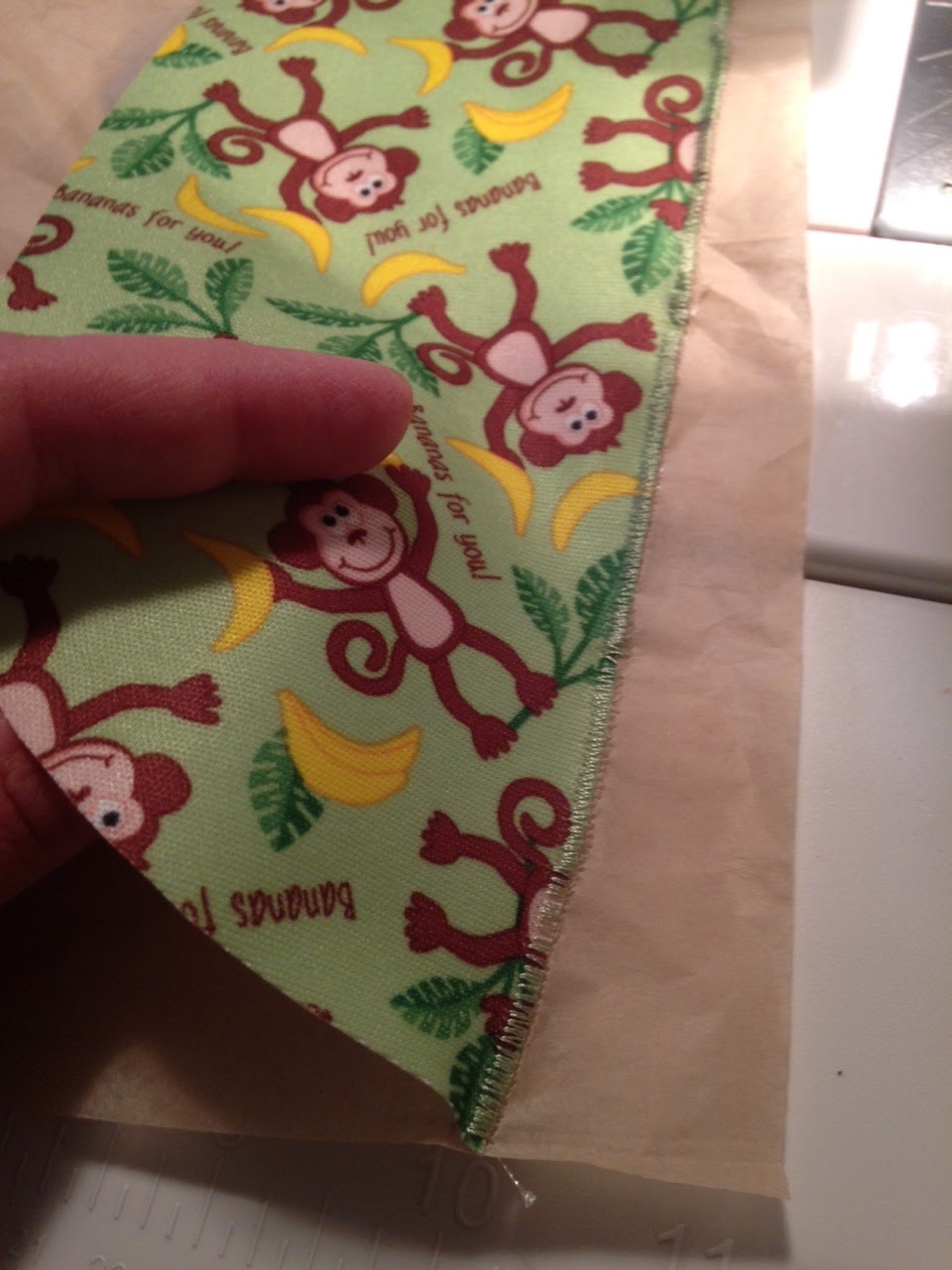
Now we move to the sewing machine. I wrote down the settings that work for my machine. Zigzag stitch that is 3.5 wide and 0.60 long. Now, the tricky thing about PUL fabric is that my machine has a tendency to want to push the fabric down into the bobbin housing. The needle sometimes has a hard time piercing through that plastic-like coating, so it just pushes it down, and be careful, because this can get your feed dogs hung up and make a HUGE bump of thread. To help counteract, I used a piece of leftover tissue paper from a gift bag and just laid it under the PUL fabric. I've also used wax paper on top of the PUL fabric. I don't know that above or below makes a difference. Either way, it gives some stiffness to the fabric and keeps it from getting stuffed down that little needle hole.


First, zig zag along the straight edge of the pocket. Align your needle so that it comes down just off the edge of the fabric when it comes down to the right.


You'll end up sewing the fabric right to the paper, but don't worry. When you've gone across that straight edge, just tear the paper off. It's easy, because your needle made ideal perforations in the tissue paper!


Next, line up the raw edges of the curved side of the pocket with the bib itself, using the little dots to get it aligned nicely. Then pin in place. I often take shortcuts when it comes to pinning, but not with this. This PUL fabric is a knit, so it's very stretchy. I've had times when I went around the length of the pocket and realized afterward that things had gotten WAY outta whack!


You don't need to use tissue/wax paper when you have the two layers together. They provide enough rigidity when used in tandem. Make sure to keep as much of your zigzig stitch ON the fabric as possible. You are using this stitch to attach the two layers to each other. GENTLY guide the fabric around the curve as it feeds through the machine. Beware of stretching!


When you've reached the other end of the pocket, stop with your needle down on the left stroke so that it holds the bib in place, then lift your presser foot, and tuck some tissue/wax paper in there again. Then proceed the rest of the way around the bib until you reach the point at which you started.


Once you're all the way around, just rip off the paper. I don't try to get too crazy with this. You can see there are little scraps that I didn't worry about tearing away. They'll just pulp up and disappear in a few washings and dryings. 


Now we attach velcro to the neck. I usually cut the fuzzy (loop) side of the velcro (my finger is pointing at it in the photo) two or three times as long as the scratchy (hook) side, so that it can make the neck hole smaller or bigger as the size of the child changes. I learned the hard way: do NOT reverse these two and make the scratchy (hook) side be bigger than the fuzzy (loop) side. When you wash and dry these bibs with other laundry, affix the velcro closed (that goes for ANYTHING with velcro), so that it doesn't snag on other things in the load (little girls' tights). If you make the hook side larger, there will be some of it exposed, and it will catch other stuff. Also, I have learned that not all velcro is created equal. I used generic (because I'm cheap) with the first bibs I made. And over time, the hook side just ripped out. It lost it's hookyness and no longer worked. Splurge on real Velcro for these heavily used bibs.


I made my zigzag length a little longer for attaching the velcro. 0.90 on my machine.
Lay the little hook-side piece on the right side of the fabric at the square corner and affix.


Lay the longer loop-side piece on the wrong side of the fabric at the end of the strap part and affix.


Then find a hungry baby and feed them!!!


These bibs are totally fine in the washer and dryer. I run them through with whatever load is going in at the time. At under $2 apiece, a few of these great bibs would make a great baby shower gift, made with love!

NOTE: You wouldn't HAVE to zigzag the single-layer edges. You could just stitch the curved sides of the pocket to the bottom of the bib, and leave the rest of it bare. I did try this to see what would happen, and it's fine. Even washing and drying. The PUL-coating prevents the edges from fraying like regular fabrics would. However, it is MUCH cuter with the zigzag fully all the way around. Proceed as you feel led!


Thursday, July 9, 2015

When I weep (and I bet you do, too!), and it's not bad...

The other night I was reading a bedtime story to my daughter, and I got to that place, the same place in this particular story that GETS me every time! We were reading, "Going West", which is a boiled-down story book in a series that condenses the Laura Ingalls-Wilder "Little House" books. If you have not taken time in your life to read the entire Little House series - stop what you are doing right now, and READ THEM ALL. I don't care what age you are, they are a thrilling, educational, heart-warming read. And when you're done with the Little House books, read the "Little Britches" book series, by Ralph Moody - reminiscent of the Ingalls-Wilder books, but from a boy's point-of-view. A bit more coarsely written, but every bit as fascinating!

But I digress, I was reading "Going West" to Hoxie, and I got to the part that always makes me cry. Up to that point, the story tells of the young Ingalls family, and how they love their little home in the woods, but they decide to go west because there is too much encroachment from other settlers. So they either pack up or sell off all their possessions, and in the dark of an early morning, they bundle up in their wool and fur clothes and load up in the wagon. But before they leave, they hear the jingling of bells and see the glow of lanterns coming through the woods - the big send-off from all of their family. And then...
My best "teacher hold". I used to sit on Mrs. Knecht's chair in kindergarten and pretend to read picture books to imaginary students.
Why does this touch me so deeply? In the space of a couple short pages in a children's book, I am reduced to tears. I think it's because I identify with the sentiment. I, myself, am far away from home. I have been the centerpiece of many family send-offs, in both my family and my husband's family. I bet you have, too. Think back to when you left for college for the first time - or for the last time. Or when you left your childhood home before moving into your own place. Or when you went on a mission trip. Or whatever your own version is. In my family, much like Laura's, whoever's home at the time usually helps carry out the suitcases and load up the laundry bags. Hugs are passed around. And then after one last wave, they call out endless warnings and directives: watch for deer... do you have enough gas? Pull around to the tank and Dad will fill you up... if you stop at a rest stop, make sure you park at the far end closer to the exit, so that you aren't at the front where other tired drivers might come in groggy and hit you... call us when you get there so we don't worry! And then they all just stand there and watch as you back up, turn around, and pull away with a perky beep and a sigh as you wipe away a tear.

But I'll tell you why this kind of crying is NOT a bad thing. Even though it can be hard, it's living proof that you are part of a family, a place, a time, where you feel loved. And though you may be far away, that love doesn't end or stop. Especially these days, the world is a small place. When Laura's family packed up and headed west, they weren't for sure where they were going or if they would ever see their loved ones again. We can FaceTime with cousins who are in their living room from our own living room in another country. Isn't that grand?

OTHER TIMES WHEN I WEEP...

When I see something "great". I don't mean neat or good or fun or enjoyable. I mean great, like an act of greatness. Something of highest quality, something to aspire to, something few others would ever be able to do. Think, Kerri Strug. If you're a fan of the Magnificent 7 (and who isn't?), by all means, watch and enjoy. If you're in a hurry, start at about 37:30 into the video.


Or if you REALLY wanna turn on the water-works, add an animal into the mix. Watch this video of bridleless freestyle reining (complete with lead changes, spins, and sliding stops) by Stacy Westfall.


Memories of the "good old days". A while back, one of my high schoolmates posted videos of our school's marching band on youtube. I was in band (yeah, I'm THAT cool), and we considered ourselves pretty intense. Not only did we accompany our school's football team every Friday night for a LONG season (our team was state champions or runners-up EVERY year that I was in high school - when your sousaphone players start decorating their instruments with Christmas wreaths you know it's gotten ridiculous), but we also competed in one or sometimes two marching band competitions every Saturday during the fall. But before that we rehearsed all summer long - a week at Indian Hills for Band Camp - rehearsals for 3 to 6 hours a day during parts of the summer - then 3 hours three nights a week once school started. Sweltering heat and sunburns. Mosquitos under the stadium lights during late-night rehearsals. Hearing "run it back" for the 2,000th time. Competing for coveted rankings and solos. Memorizing music and drills. Marching (and trying not to slip and fall) in the rain and mud. Jazz running! Shivering in blistering cold and trying not to freeze your lips to your metal mouthpiece (I was a trumpet player - but other instrumentalists had different concerns - let me just say, "clarinet condoms"). Trying not to let the reverb of performing in a large stadium (or even the RCA dome, then home of the NFL's Indianapolis Colts) mess with your timing and synchronization. The nerves that come with performing in a stadium full of fans and critics, and praying that you don't frack, squeak, or run out of chops. And shall we mention the elephant in the room? Trying to create GOOD music while running around on a field! What made us DO it?

Your memories may not include band specifically, but I bet you were into your own thing... sports, mock trial, drama productions, you name it. We were just a bunch of crazy, pixie-stix-shooting teenagers. Working together. Taking ourselves and our tasks seriously. But having fun and sporting some AWESOME fashion and hairstyles while doing it - don't you miss the '90s? That commitment, the idea that we were all fully bought-in. For a bunch of bratty teenagers, it's really touching how we all threw ourselves into the hard work, the long hours, the pressure. When I look back at the videos and remember, for some reason it take my breath away.


If you look closely you'll be able to see/hear a quaking-in-terror little freshman trumpet player in the center of a quintet on the 50 yardline at about 2:38 into the video. That's me!

Of course, crying is just an outward expression of emotions we have on the inside. Sometimes crying indicates distress or sadness. But sometimes it just happens when your heart overflows.

Wednesday, July 1, 2015

How well do you really know your neighbor?


As most of my family and friends are actually Americans (I'm from Ohio, and Eric is Nebraskan), I thought maybe it was a good time to talk about my current country of residence. Many of you may not actually realize... today is Canada Day! Here are some interesting (or at least interesting to me) things you may or may not know about the Great White North, along with some things I've observed since moving here in 2010. Note: I'm not including any references - some is personal experience and some is from the interweb, and we all know everything you read there is true.

It's sparse. Canada is the second largest country in the world, behind Russia. It is bigger than the USA, but it has about 1/10th of the population - just 35 million people. If it weren't for immigration, Canada's population would probably be shrinking. It is the 8th LEAST dense country in the world. There is a LOT of area here where there is no one around. NO ONE.

Canada became its own country in 1867. Well, wait, I'm not really sure. I've also read 1931. And also 1982. And actually, I think it's STILL sorta considered part of the British commonwealth. The queen is on our money. And did you know - our money is colorful? Wait - colOURful. 5s are blue, 10s are purple, 20s are green, and I don't know anything higher than that because I never have them myself.

When we first moved here, I rented a 13-dvd set from our local library about the history of Canada, and I remember the scene where Canada first gained its independence from England. They sent three of their leaders to the queen and ASKED if they could be their own country. Now, think back to how the USA got its independence - it was called the Revolutionary War. People fighting and dying. Terrible bloodshed and unrest. And all Canada did was ASK. Now, I know there was MUCH more to it than that, but my point is, Canadians really ARE nice!

Where we live in Alberta, we commonly experience drastic changes in temperature, due to Chinook winds, which I've heard are part of the larger Santa Anna winds from California. They bring warm air up and over the Rockies and melt our snow away. "Chinook" is the native word for "snow eater". The biggest temp swing record was in Pincher Creek, AB, when it went from -2ºF to 72ºF in one hour! I've never experienced anything THAT dramatic, but we often see the Chinook arch in the sky - it's a pinkish colored sky, where the clouds are in an arch shape - and some people get killer Chinook headaches.

Right now the Canadian dollar is weak. It takes about $1.25 Canadian to equal $1 USD. It cyclically fluctuates.

(Pause) Stepped onto the back deck to watch the C-Day fireworks. At this moment it is 10:52pm, and there's still quite a bit of light left in the sky, but it's just now dark enough to see the fireworks.

There are two official languages in Canada - English and French. I don't know a lot of people who solely speak French. It's not common as far west as we are. That's more in Quebec. Still, most of our road signs are in both languages. And many of our towns offer "french immersion" schools - public schools where the teachers and students all speak french the whole time. These are regular kids (we have several friends with kids in french immersion) learning regular subject matter - history, math, geography, etc. - but learning it while speaking french. Another thing that blew my mind was that Catholic schools are considered public school - and are free.

Speaking of school, did you know that Canadian school children are actually required to learn American social studies? They learn our states and capitols, our important dates, and our political and economic systems. I THINK I might have learned the national capitol of Canada - of course, I'm talking about Toronto. Gotcha! I was testing you! It's Vancouver. Okay, SEE how little I learned about Canada? And Canadians know all kinds of stuff about the USA. (And many of them really resent having been required to learn it... not that I really blame them.)

Every month has at least one holiday. There are some months where it's a given - like Canada Day or Thanksgiving. But for any month that doesn't already have a holiday, they just take off the first Monday of the month. So, like, in May, we observe May Long Weekend. And August Long.

Much like various parts of the USA, there are regional terms and dialects here that sometimes cause me confusion.
• "College" is strictly used for 2-year, trade-type post-secondary education - think junior college.
• "University" is the 4-year experience where you change your major six times and go on study abroad - like what I did. They literally say stuff like, "Cayden's going off to University next year."
• Dinner rolls and cinnamon rolls are called "buns".
• You "have" a shower - you don't "take" it.
• A "hoser" is a thrown out term for a bum, a bozo, a joker, a turkey.
• The plastic thing they put your groceries in is a "bag" - never a "sack".
• "Smarties" are chocolates with a candy-coating - like a larger M&M, and smarties (sweet tarts) are called "rockets".
• "Poutine" is fries with cheese curds, drowned in brown gravy - and often lots of other things. It's Quebec slang for "a mess". It's wonderful.
• What I call mac & cheese is strictly called "Kraft Dinner". Mom, can we have KD tonight?

We have nothing bad to say about the socialized health care system in Alberta. Eric broke a wrist, and I broke a nose. Eric got kicked in the head by a horse and knocked unconscious, taken by ambulance to the ER. I've had two babies here. We've had the run-of-the-mill winter sickness and infections, and of course the expected crud that kids get from time to time. But we are young and basically healthy. We've never had to wait in much of a line or been denied for anything. And we've never paid a dime out of pocket. And believe or not, on the whole our taxes are lower here than they were when we were living in Iowa (do you like how I can read your next thought?)! Oh, and also - we get $200 a month just for having kids, it's called a "child benefit". And we can claim some of their education and physical study expenses on our taxes (think, piano lessons, gymnastics, etc.).

My daughters, Hoxie (2.5 yrs) and Cordelia (1) were both born here and are both Canadian AND American citizens.

Canadians ARE really polite - they DO apologize for everything, even if it's not their fault. And they ARE really funny. Some notable Canadian comics: Dan Aykroyd, Will Arnett, John Candy, Jim Carrey, Tommy Chong, Michael J. Fox, Tom Green, Phil Hartman, Eugene Levy, Norm MacDonald, Howie Mandel, Lorne Michaels, Rick Moranis, Mike Myers, Leslie Nielson, Catherine O'Hara, Ryan Reynolds, Seth Rogan, William Shatner, Martin Short, and more!

One of the funniest people I love now but had never heard of before coming north is Rick Mercer. Search youtube for "Rick Mercer - Talking With Americans" - hilarious!


About 39% of Canadians are Roman Catholic. About 28% protestant.

We have most of the same TV channels you have in the USA, plus some specifically Canadian ones.

Yes, we have same-sex marriage (since 2005).
No, I've not yet met Justin Bieber.
Yes, we have Walmart and MacDonalds.
No, we don't have JoAnn Fabrics - I KNOW you were wondering.
Yes, hockey really is LIFE.

Honestly, for the most part, you wouldn't really even realize you're in a different country. We are much more ALIKE than we are different. And isn't that really the way it is the world-over?